 GAMUT
GAMUT Essay · Part 1
Part I. Why Music Wants a Geometry
The opening essay turns away from familiar categories and asks what kind of map could organize the full space of twelve-tone possibility.
A list can name musical objects. A geometry can let a mind move among them.
The impossible atlas
A piano keyboard invites a flattering illusion. It suggests that musical possibility is laid out before us in a neat sequence, visible and finite, like a well-ordered street. There are twelve pitch classes in the chromatic system, and after a lifetime spent hearing scales, chords, cadences, arpeggios, and riffs, it is tempting to think that the space of musically meaningful objects is therefore large but manageable. One imagines a shelf of familiar categories: major and minor, dominant and diminished, modes, scales, rows, progressions. The imagination is wrong.
The moment one stops asking for the familiar and instead asks for the possible, the floor drops away. If we care only about pitch content and ignore octave placement, then every musical object is some subset of the twelve pitch classes. There are 2^12 = 4096 such subsets. That number is already large enough that no ordinary theoretical vocabulary can hold it comfortably. But content is only the first layer. If order matters, the numbers become much worse. There are 12! distinct ordered arrangements of all twelve pitch classes, which is 479,001,600 possible twelve-tone rows before one has said anything at all about rhythm, register, repetition, or emphasis. If one allows ordered collections of any cardinality from one note up to twelve distinct notes, the count rises past 1.3 billion. None of this is paradoxical. It is simply the cost of taking musical possibility seriously.
And yet human hearing does not meet that enormity as a spreadsheet. It meets it as shape. We do not merely catalog sounds; we feel neighborhoods, analogies, returns, tensions, shortcuts, symmetries, and singular landmarks. We hear that a major triad belongs somehow near a minor triad and far from a chromatic cluster. We feel that the whole-tone collection is less locally directional than the diatonic scale. We recognize that a diminished seventh chord has a peculiar self-similarity, as though one could rotate it and lose track of where it began. These are geometric intuitions before they are theoretical conclusions. They suggest that what music needs is not just a nomenclature, but an atlas.
The trouble is that inherited theory, brilliant as it is within its own historical corridor, was not designed to chart the whole territory. Functional harmony is a theory of directed motion in a particular repertorial world. Modal theory is a theory of scalar behavior under another set of stylistic assumptions. Serial theory widened the lens, but even there the practical focus often remained on special classes of ordered objects rather than on the total shape of the space they inhabit. Each of these theories sees something real. None of them, by itself, gives a satisfying answer to the simplest global question: what would it mean to picture the universe of twelve-tone pitch objects in a way a human mind could actually navigate?
To ask that question is already to move from grammar to geometry.
Folding the keyboard into a clock
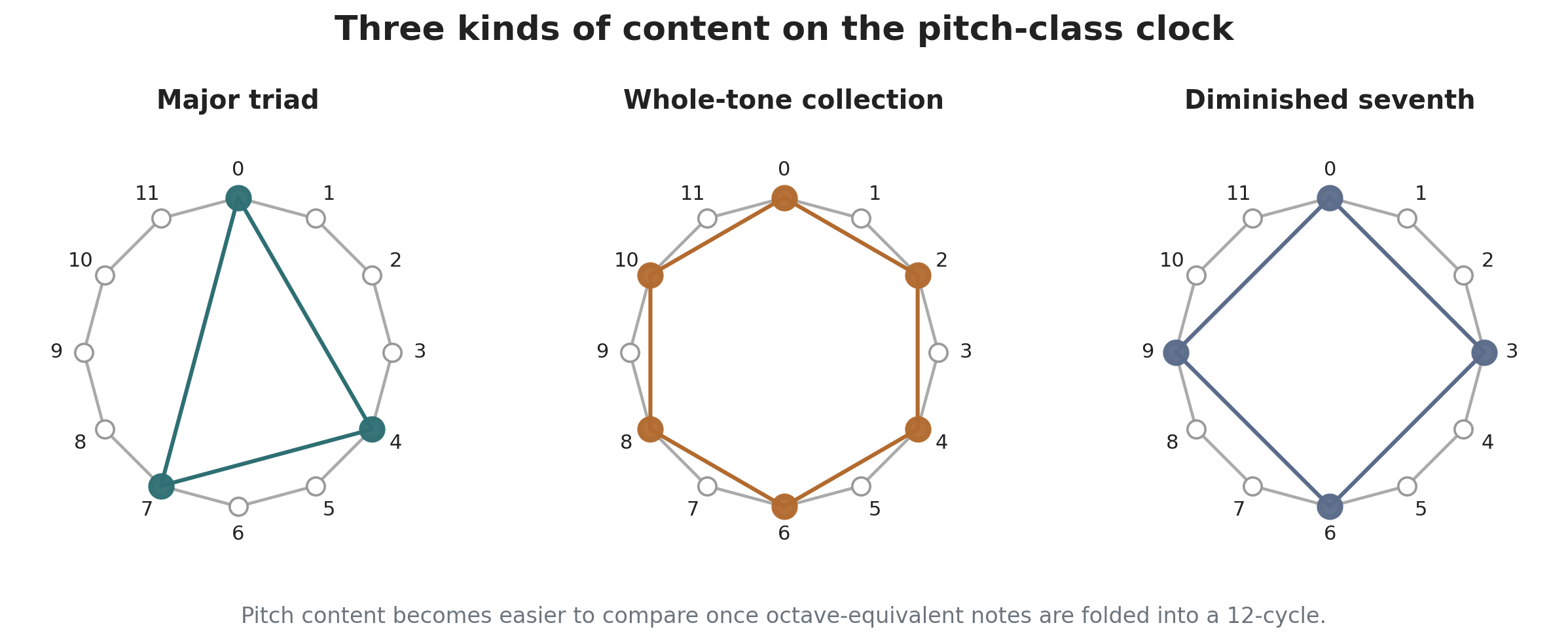
The first act of compression is both severe and liberating. We stop treating pitches as isolated events in acoustic space and instead identify notes that are separated by octaves. C4, C5, and C6 cease to be distinct destinations and become three registrations of a single pitch class. The keyboard folds into a circle of twelve positions. This is not yet a theory of music; it is a decision about what counts as the same for the purpose of a first map.
Once that decision is made, the natural ambient space is Z_12: twelve positions arranged not in a line but on a loop. That loop matters. A line has edges; a circle does not. On the line, B and C look far apart because the notational alphabet breaks there. On the circle of pitch classes, they are neighbors. The step from the keyboard to the clock is therefore not just a convenience. It is the first recognition that chromatic pitch organization is inherently cyclic.
Within this clock, a musical object can be represented simply by the positions it occupies. A major triad becomes the set {0, 4, 7} after choosing some temporary zero. A whole-tone collection becomes {0, 2, 4, 6, 8, 10}. A diminished seventh chord becomes {0, 3, 6, 9}. One may then go a step further and identify sets related by transposition or inversion. A C-major triad and an E-flat-major triad become instances of the same abstract content. Under transposition/inversion equivalence, even larger families collapse together. This is not an evasion of difference; it is a principled folding along symmetries that the first approximation does not need to distinguish.
That reduction can feel like loss, but it is better understood as a quotient. In mathematics, a quotient is what happens when we identify points that differ only by a symmetry we no longer wish to track. Rotating the pitch-class clock does not change the intervallic shape of a set. Reflecting it does not change its inversional profile. So the space is folded along those motions. What emerges is not a smooth picture in the ordinary sense, but a compressed one. Many superficially different musical objects collapse to a single abstract type.
This already explains something that ordinary musical language often leaves mysterious. Why do all major triads feel like instances of one thing? Why do major and minor triads feel related at a deeper level than either does to a tone cluster? Why does the diminished seventh chord seem unusually slippery and self-similar? The answer is that some objects have more symmetry than others. Most pitch-class sets have the full expected collection of distinct transpositions and inversions, but symmetrical sets have fewer distinct forms because nontrivial transpositions or inversions map them back onto themselves. Symmetry is not an ornamental property of the space. It is one of the forces that shapes it.
At this stage, one might think the problem is nearly solved. There are only finitely many set classes. They can be named, listed, and grouped by cardinality. Twentieth-century music theory did exactly this with admirable rigor. Allen Forte’s classification assigns each transposition-inversion equivalence class a canonical label of the form k-n, where k is the cardinality and n is the ordinal within that cardinality group. Under this system the 4096 subsets of the chromatic aggregate collapse to exactly 223 distinct set classes. Many of these classes correspond to objects that every musician already knows by ear, even if not by number: 3-11 is the major/minor triad, 4-27 is the dominant/half-diminished seventh chord, 7-35 is the diatonic scale. Others — 5-Z12, 6-Z44, 8-22 — lack familiar common names but occupy no less definite a position in the pitch-class universe. The Forte catalog is, in effect, the periodic table of twelve-tone content: compact, exhaustive, and indispensable as a naming scheme.
But a list is not yet a geometry. A classification tells us which objects are equivalent. It does not yet tell us what should count as near.
Why naming is not enough
Imagine being handed a periodic table without any indication of adjacency, valence, or structure. It would still be useful. One could name things. One could sort them. But one could not yet think spatially about chemical behavior. Something similar happens in musical set theory. Knowing that the major/minor triad is Forte 3-11 and that the whole-tone scale is Forte 6-35 does not, by itself, tell us how the two are related, how far apart they sit, or what bridges connect them. Naming a set class is not the same as understanding its position in the larger terrain.
There are several reasons for this. The first is psychological. Human beings do not think well in exhaustive tables once the table becomes large. We think better when we can recognize regions, bridges, bottlenecks, and special cases. The second is musical. The reason theorists care about content classes at all is not because naming is satisfying for its own sake, but because similar content tends to support similar sonic affordances. The third is conceptual. The moment we begin talking about similarity, we have entered the domain of metrics, neighborhoods, and embeddings whether we say so or not.
Traditional pitch-class set theory offers one important bridge from naming to comparison: interval content. One may summarize a set by counting how many intervals of each size occur within it. This gives a compact signature of the set’s internal makeup, and it often captures a great deal of what listeners mean when they speak of a collection’s color or profile. But even here one senses the deeper question pressing in. A summary is not yet a location. It tells us how many intervals occur, but not how the set is arranged around the cycle. It is useful precisely because it forgets something. The real question is whether there is a more fundamental operation beneath this summary: something that does not merely tabulate intervals, but arises naturally from the cyclic structure of the pitch-class clock itself.
This is where cyclic autocorrelation enters the scene.
Duncan’s fingerprint
Andrew Duncan’s work on combinatorial music theory is especially suggestive because it does not begin with the language of harmonic function or stylistic usage. It begins with a periodic object and asks how that object overlaps with itself under cyclic shift. The move is mathematically simple and musically deep. One treats a pitch-class set as a pattern on a twelve-point circle and measures what survives when the pattern is rotated against itself.
Take a pitch-class set S contained in Z_12. Define its indicator function χ_S(n) to be 1 when n is in the set and 0 otherwise. Then define the cyclic autocorrelation of S by
A_S(τ) = Σ_{n ∈ Z_12} χ_S(n) χ_S(n + τ).In plain English, this asks: if I shift the set around the pitch-class circle by τ semitones, how many points does it share with its original position? The answer is a twelve-entry cyclic fingerprint. At lag zero, the set overlaps with itself completely, so A_S(0) is just the number of notes in the set. At other lags, the entries count how often intervals of that size occur inside the set. Because the space is cyclic, this overlap-counting procedure is perfectly adapted to the object being studied. And because it counts overlap after rotation, it is automatically insensitive to where the set begins. That is exactly what a good content fingerprint should do.
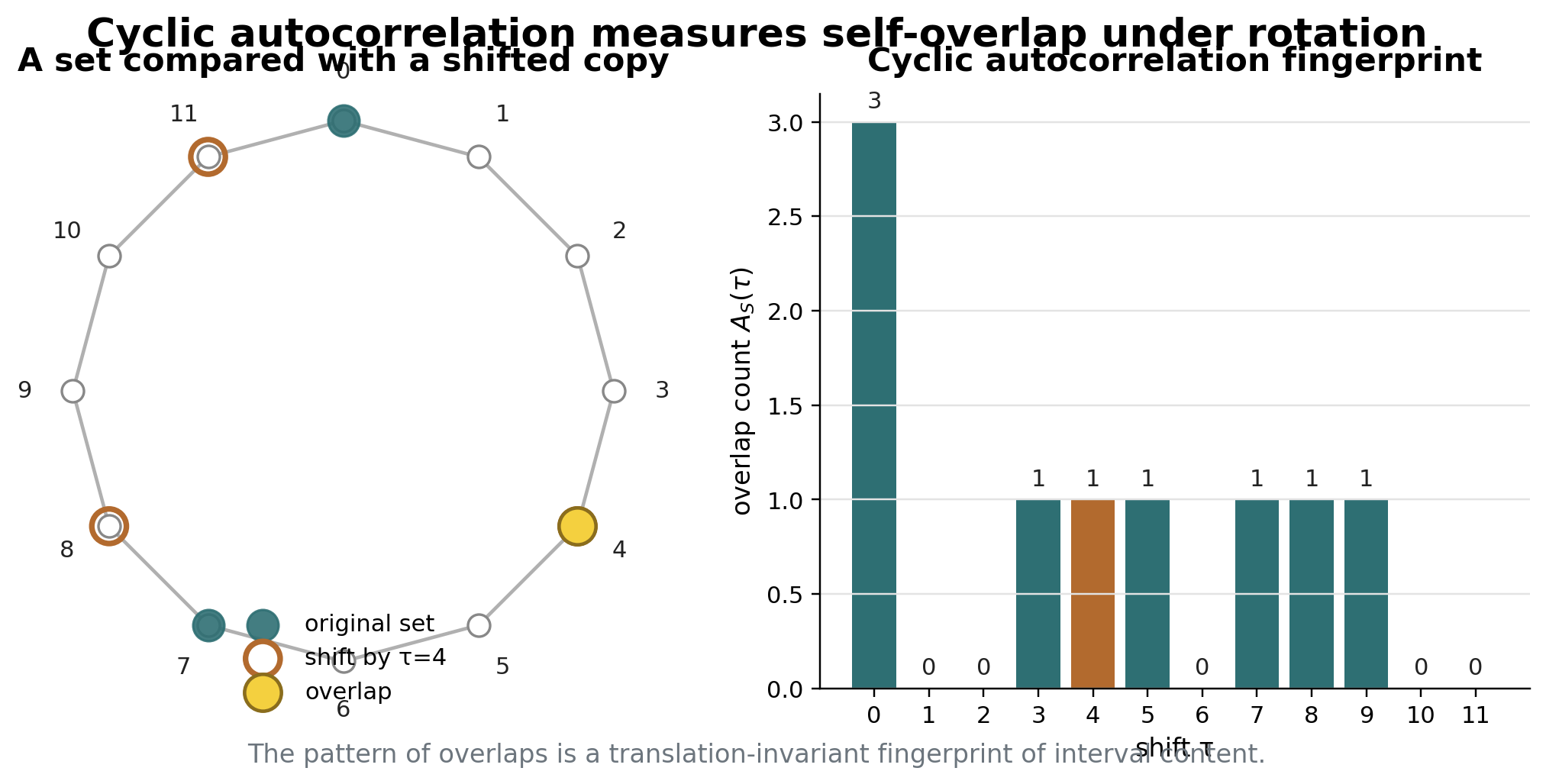
One can see immediately why this is more than a fancy reformulation of interval counting. The operation is geometric in spirit. It does not ask first for a label. It asks how a shape behaves when moved around its native space. A major triad (3-11), a whole-tone collection (6-35), and a diminished seventh chord (4-28) all leave different overlap traces when shifted around the twelve-point cycle. Those traces are not arbitrary statistics pasted onto the object after the fact. They are responses of the object to motion.
This is the first truly persuasive reason to say that music wants a geometry. The relevant invariants arise not from a taxonomy imposed from outside, but from an operation internal to the space itself.
The Fourier shadow
There is a second reason this idea matters, and it is easy to miss if one focuses only on the counting interpretation. Cyclic autocorrelation has a spectral twin. By the finite Wiener-Khinchin correspondence, autocorrelation and the squared magnitude of the discrete Fourier transform carry the same information. One may read the structure either in the domain of overlap or in the domain of modes.
For music, this means that the same pitch-class set can be understood in two coordinate languages. In one language, we count how the set overlaps with itself under cyclic shift. In the other, we measure how strongly different Fourier modes are present in the set’s characteristic function. What sounds like two theories is really one theory seen from opposite sides.
That equivalence matters because it explains why interval content and spectral shape keep reappearing together in modern music theory. It also plants a seed for everything that comes later. If the cyclic fingerprint of content already has a Fourier shadow, then musical geometry is not merely combinatorial. It is already brushing against a phase space. The richer mathematics to come are not imported artificially; they are latent from the start.
At the level of this first essay, the point is simpler. Cyclic autocorrelation gives us the first serious coordinate system for content. It is musically meaningful, mathematically natural, and adapted to the cyclic world in which pitch classes live.
And yet it is not enough.
Slonimsky and the pressure of order
Before explaining the incompleteness of content-based fingerprints, it helps to notice another pressure that has been building all along. Musicians do not care only about membership. They care about traversal.
This is one reason Nicolas Slonimsky’s Thesaurus of Scales and Melodic Patterns remains so revealing. However eccentric the book may appear at first glance, its governing intuition is not eccentric at all. It organizes patterns by interval cycles and then generates richer patterns by interpolation, insertion, and ornamentation. Slonimsky is not merely cataloging pitch collections. He is cataloging ways of moving through them.
That historical fact matters because it uncovers a structural distinction. If the pitch-class set answers the question “what notes are present?”, the ordered pattern answers the question “how are they traversed?” These are not rival descriptions. They are different layers. A scale may be treated as content when we abstract away its order, but as pattern when we care about its steps. A chord may be treated as content when we ask about interval makeup, but as arpeggiated motion when we care about voice-leading or melodic realization. Slonimsky’s enduring value lies in the fact that he forces the second question back into view.
The consequence is unavoidable. Any geometry of musical possibility that captures content but not traversal will be useful, but partial. It will tell us what is there, not how it behaves from within.
Where the first fingerprint fails
The incompleteness of content-based fingerprints is not merely philosophical. It is mathematically explicit. Autocorrelation records interval content. Interval vectors record interval content. The magnitudes of the discrete Fourier coefficients of a pitch-class set also record, in another guise, interval content. But there exist pitch-class sets that share this content without being equivalent under transposition or inversion. In music theory these are called Z-related sets — the “Z” in Forte numbers like 5-Z12 and 5-Z36 signals exactly this phenomenon — and in broader mathematical language they are homometric sets.
The significance of these examples is easy to understate. Two genuinely different sets can cast the same intervallic shadow. Or, in spectral language, two different objects can have the same Fourier magnitudes. Something positional has been lost. When we count pairwise spacings, we remember how many intervals occur but forget enough of their arrangement that distinct objects can collapse onto the same signature.
This is not a technical nuisance. It is the turning point of the whole project. It tells us that interval content, though powerful, cannot be the whole story. The first layer of the map succeeds and fails at once. It succeeds because it gives us a natural, transposition-invariant coordinate system for content. It fails because musical objects are not exhausted by their interval counts. Content has shape beyond content, and pattern has shape beyond membership.
Why the object must be layered
The lesson of the last two sections is subtle but decisive. Duncan shows that cyclic autocorrelation gives a mathematically natural fingerprint for pitch content. Slonimsky shows, from another direction, that ordered traversal is structurally real and musically irreducible. Z-relatedness shows that even the best content fingerprint is incomplete. Taken together, these facts imply that the space we want cannot be flat.
There is a base layer consisting of pitch content up to symmetry, and there are further layers that preserve information discarded by that base. Order is one such layer. Positional or phase-sensitive information is another. The right global object, then, will not be a single uniform cloud of points. It will be a layered construction in which one level records what is present and another records how that presence is internally organized or traversed.
This layered view is not only mathematically cleaner; it is closer to musical experience. When we recognize a sonority, we recognize its content. When we recognize an arpeggiation, a scalar figure, or a melodic cell, we recognize an ordering of that content. When we distinguish two homometric objects that “contain the same intervals” yet do not sound or behave the same, we are responding to structure that survives beyond unordered interval counts. In each case, perception itself is already stratified.
A geometry adequate to music must therefore do two things at once. It must compress by symmetry, because otherwise the raw combinatorics are unthinkable. But it must also preserve enough layered distinction that compression does not become erasure. This is why the project does not end with a set-class table or an interval vector. Those are indispensable instruments of reduction, but they are not the final image of the space.
Threshold
We can now say what this first essay has accomplished. It has argued that the universe of twelve-tone musical objects is too large to be understood as a mere list. It has shown that the first necessary simplification is to move from pitches to pitch classes and then to quotient by transposition and inversion. It has identified cyclic autocorrelation as the first genuinely geometric fingerprint of pitch content: a way of reading a set by its self-overlap under cyclic motion. It has noted the Fourier shadow of that fingerprint and the deeper spectral language it implies. It has used Slonimsky to show that order is not an optional afterthought but an independent axis of structure. And it has used homometric and Z-related examples to prove that content alone, however elegantly summarized, cannot be the whole map.
What we possess, then, is not yet the geometry of musical possibility, but its first coordinate chart. We know how to speak about content as a cyclic object. We know why symmetry forces us to fold the space. We know why the result is informative but incomplete.
The next step is to attach the missing structure rather than merely lament its absence. Content gives us the answer to the question of what notes are present. What remains is to describe the local worlds of order that hang above each content class, and to show how those worlds can be assembled into a single intelligible object.
Content gives us a map of what is present, but not yet of how a musical object internally unfolds.
Source notes & further reading
- Allen Forte, The Structure of Atonal Music (Yale University Press, 1973) — the foundational taxonomy of pitch-class sets and interval vectors.
- John Rahn, Basic Atonal Theory (Longman, 1980) — formalizes pitch-class set operations and equivalence classes.
- Andrew Duncan, “Combinatorial Music Theory,” Journal of the Audio Engineering Society 39, no. 6 (1991): 427–448.
- Ian Quinn, “General Equal-Tempered Harmony,” Journal of Music Theory 50/2 (2006) — Fourier-based approach to pitch-class profiles.
- Emmanuel Amiot, Music Through Fourier Space (Springer, 2016) — comprehensive treatment of the discrete Fourier transform on pitch-class sets.
- Jason Yust, Organized Time: Rhythm, Tonality, and Form (Oxford University Press, 2018) — develops DFT-based content analysis.
- Nicolas Slonimsky, Thesaurus of Scales and Melodic Patterns (Schirmer, 1947) — the original systematic enumeration of interval cycles.