 GAMUT
GAMUT GAMUT — Geometric-Algebraic Music Theory
The shape of musical possibility.
How can a musical idea keep its identity as it changes? Explore pitch content and order, a foundation checked in Lean, and a research path toward instruments that help musicians carry what they hear inwardly into sound.
Content & order
One collection. C, E, G
First ordering
- C
- E
- G
Second ordering
- C
- G
- E
What is established.
What comes next.
Discrete foundation: ten Lean proof contracts, with explicit assumptions. Read the proof coverage and the maintained proof paper.
Numerical projections, sampled orderings and musical utility are not certified by Lean. The musical utility agenda asks what would make this playable and useful.
The essay sequence
Follow the idea.
From a musical question to a mathematical model, in three parts.
Visit the essay guide-
Part I. Choosing a Geometry for Musical Ideas
What a pitch-class map can preserve, what it leaves out, and why interval fingerprints need to be distinguished from complete representations.
-
Part II. Attaching Order to Content
How two traversals of one triad lead to exact reconstruction, finite ordering fibers, and a proposed musical transformation task.
-
Part III. From Structure to Musical Expression
What a chosen symplectic model adds to a musical map, what Lean verifies, and how a performer might put the relationships to use.
Optional technical companion Part IV. What Musical Representations Preserve
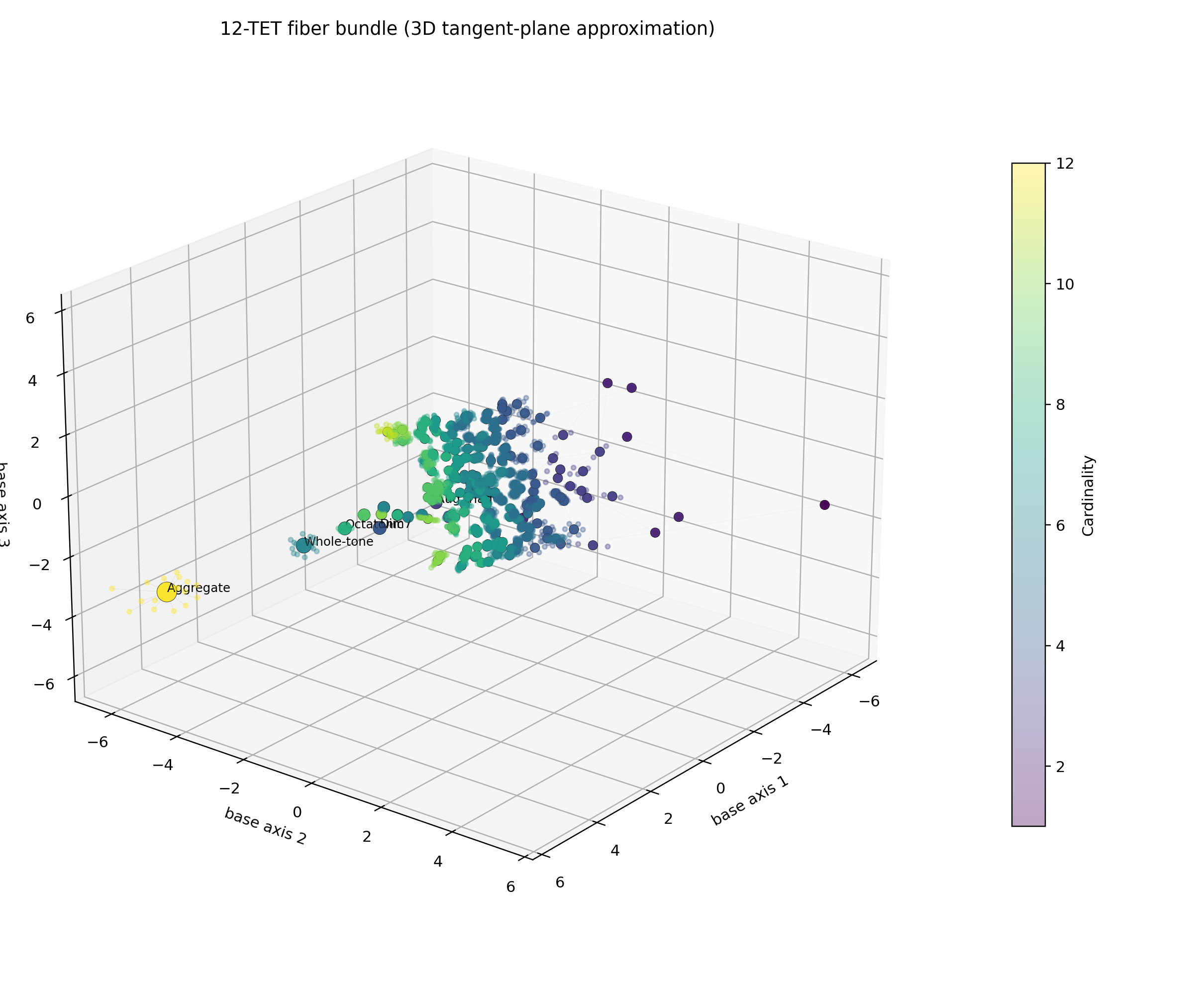
An interactive atlas
See content.
Explore its orderings.
Choose a pitch collection and inspect its local ordering space in the Layered Bundle Explorer.
Views are numerical projections; larger ordering spaces are sampled. Displayed distances and topology are not certified by Lean.
All visualizationsGo deeper
Inspect the foundations.
Follow pitch-class content, finite ordering fibers and Fourier coordinates into the chosen continuous geometry. The definitions keep the discrete construction and its ambient extension distinct.
Mozart: three works around 26 June 1788
A symphony, a sonata for beginners and an adapted fugue share a catalogue date. The first historical dossier examines their documents and scores, and asks where evidence gives way to interpretation.
Research draft. Direct comparative listening and targeted source checks remain open.
Read the essay draft: A date is not a state of mind